Why Playing Faster Isn't the Same as Playing in Control
Why Playing Faster Isn't the Same as Playing in Control
Most drummers measure progress in one number: BPM. Hit a higher tempo, feel like you've improved. It's simple, it's trackable, and it's often wrong.
Speed and control aren't the same thing, and chasing one without the other is how a small, manageable flaw turns into a habit that's much harder to unwind.
Why a habit hides at low tempo
Small technique flaws don't always show up right away. At a slower tempo, there's enough time between strokes for a flaw to stay invisible, a slight twitch, a compensation, an inefficient reset, none of it disrupts the groove enough to notice.
Push the tempo up and that same flaw runs out of room to hide. What was a barely-there twitch at 105 BPM becomes a visible breakdown at 120. The habit didn't get worse. The tempo just stopped giving it anywhere to hide.
The trap of pushing through it
The instinct at that point is usually to push harder. Grind at the higher tempo until it feels less bad. The problem is that repetition at speed doesn't remove the flaw, it just trains your body to execute the flaw faster and more automatically.
This is what we call the Tempo Trap: mistaking speed for control, and reinforcing the exact pattern that's limiting you, just at a higher tempo where it's harder to unlearn later.
Across the hundreds of stuck-drummer calls we've reviewed, this pattern shows up constantly. In most cases, the flaw wasn't new at the higher tempo, it was already there at a lower tempo, just quiet enough not to disrupt anything. The higher BPM didn't create the problem. It just removed the room the problem had been hiding in.
A real example
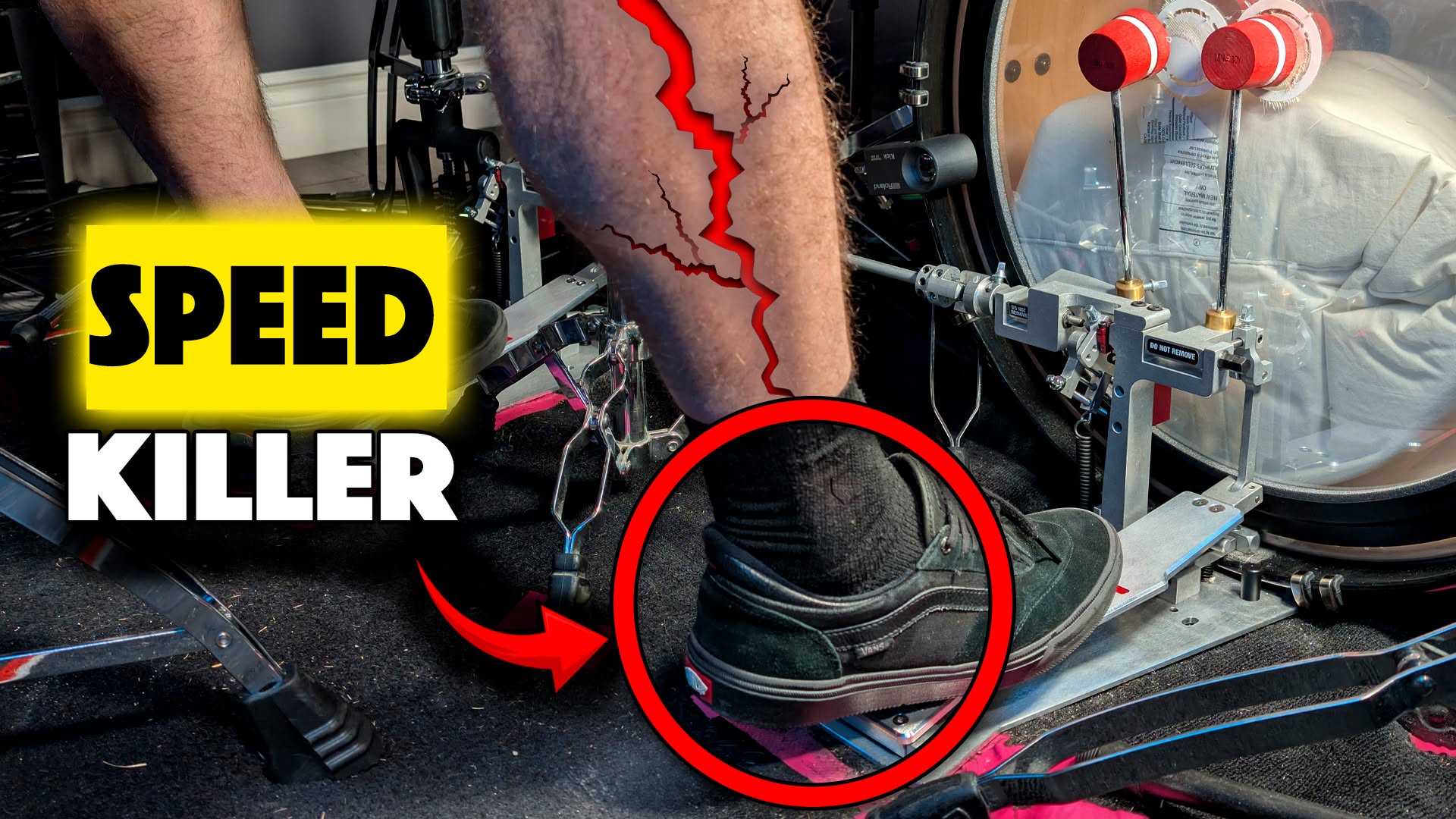
One of our students had an ingrained ankle twitch left over from an old heel-toe pattern. It didn't show up at 105 BPM. At 120, it appeared consistently and threw off his timing.
Instead of grinding at 120 until the twitch "went away" on its own, which it wasn't going to, we backed the tempo down and built an entirely different movement pattern from the ground up: a leg drop technique driven from the hip and thigh, with the ankle staying passive instead of doing the work. Rather than fighting the old habit head-on, he replaced it with a pattern that didn't have the same failure point built in.
That's a different approach than "practice through it," and it's the reason speed at that tempo is now sustainable instead of masking a flaw waiting to resurface.
Why we measure it this specifically
Part of why this diagnosis starts with muscle and tempo is that it's tangible. Which muscle is doing the work, and at what exact tempo the breakdown starts, are both things you can actually see and measure, not vague impressions like "it just feels off." That gives us a concrete starting point to test, adjust, and re-test.
But that's the entry point, not the full picture. What's happening underneath a visible breakdown is rarely just muscular. There's usually a neurological component (how fast the nervous system can actually redirect force) and often a psychological one too, tension, hesitation, or overthinking creeping in right around the tempo where things start to feel risky. The muscle and the BPM are what we can see and measure first. What's actually driving the breakdown often lives one or two layers deeper than that.
What this means for your own practice
If a certain tempo consistently breaks something down, that's not a signal to grind harder at that tempo. It's a signal that something underneath is being asked to do more than it can handle cleanly. Speed isn't the goal, control is. Speed is just what control looks like once it's actually there.
Before pushing your BPM further, it's worth figuring out whether what's underneath your current tempo can actually support it, or whether you're about to train a flaw in faster instead of fixing it.
A quick self-check
Back your tempo down 10-15 BPM from your current ceiling and pay close attention. If the same flaw is still there, just quieter and easier to miss, that's a strong sign it was never actually a speed problem. It was there all along, the higher tempo just stopped letting it hide.
Book a free diagnostic call and we'll find out which one it is before you spend more time reinforcing the wrong pattern.
